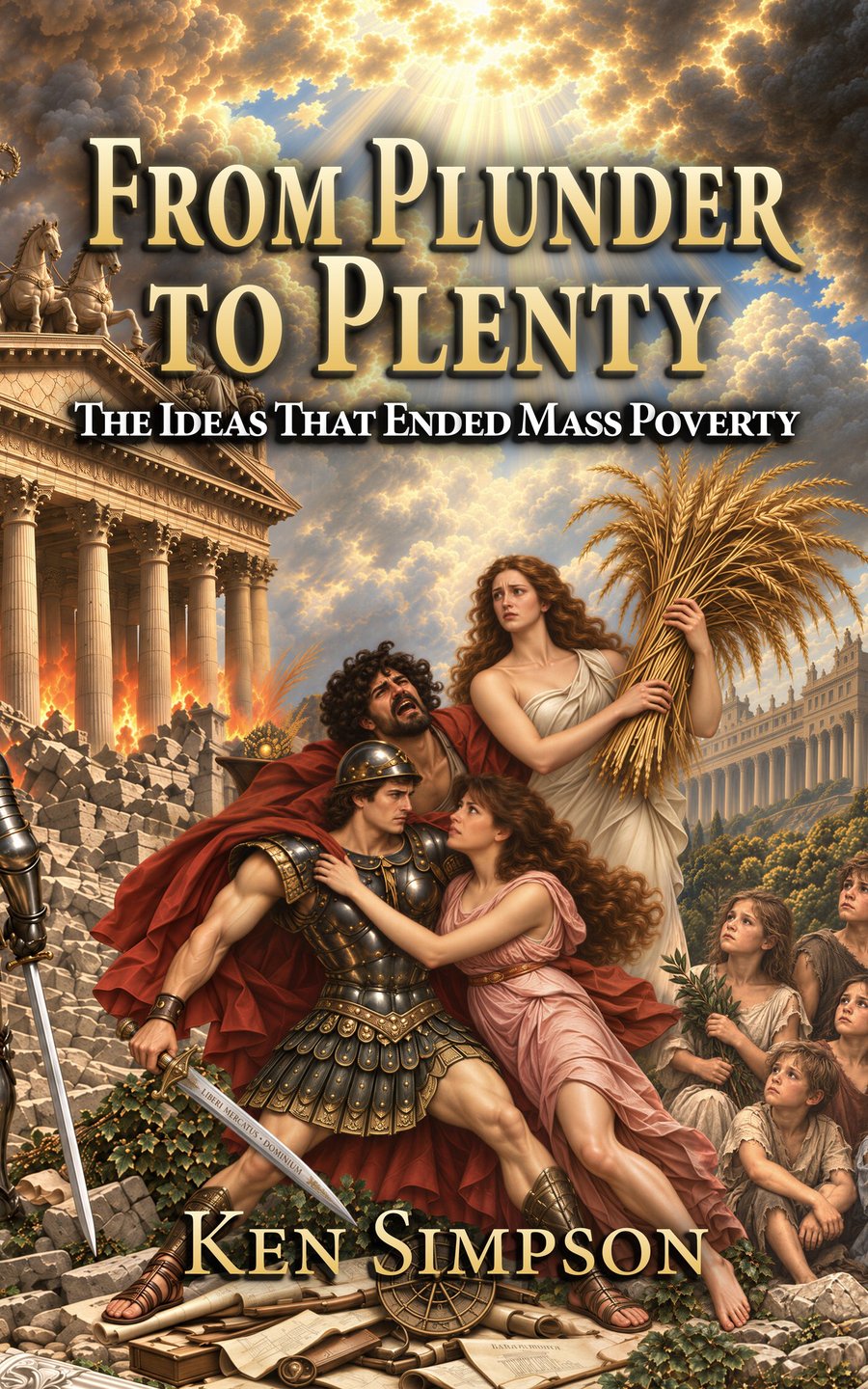
A book by Ken Simpson
When the rich get richer, do the rest of us get poorer?
Half of us say yes. For three hundred thousand years, we would have been right. Then, around 1800, that world was overturned—and most of us were never told it happened.
The Greatest Thing That Ever Happened to Us
For three hundred thousand years, wealth was a hoard, and the only way to get more was to take it from someone weaker. Kings grew rich by beggaring their neighbors. Ordinary people lived and died at the raw edge of hunger. The fixed pie was not a theory. It was a fact.
Then, around 1800, that world was overturned. Within two centuries the share of humanity living in crushing poverty fell from three in four to one in ten. From Plunder to Plenty tells that story and answers the question at its center: from where does wealth come? Not from better tools or harder work—humanity had both for ten thousand years and stayed poor. Two ideas did it. Both are humble, both are easy to lose, and both are under attack again, dressed as fairness.
The ancient certainty that a fortune must be a theft never died. This is the question of our time.
Inside the Book
- Why a better plow made another peasant instead of a richer one, and what finally broke the trap
- Adam Smith's discovery, the hockey stick that followed it, and why trade is not war
- The case against wealth—Marx, Piketty, Rawls—quoted in its own words, at full strength, and answered
- Where the inequality numbers come from, and what the famous charts leave out
- Inflation, price controls, tariffs, and the wealth taxes a whole continent tried and gave up
- The twentieth century's ledger: what happened everywhere the pie was seized instead of grown
- What a positive-sum society must protect, and what it owes the people change leaves behind
Part I — The Fixed Pie
Games People Play · A World Made of Takings · The First Surplus · Mercantilism: Zero-Sum as Official Doctrine
Part II — The Pie That Grew
The Idea That Broke the Trap · Adam Smith and the Positive Sum · The Hockey Stick · Why Trade Is Not War
Part III — The Case Against
Marx and the Theory of Exploitation · Piketty and the New Zero-Sum · The Psychology of the Fixed Pie
Part IV — Plunder and Plenty
The Signal · The Oldest Plunder · The Ledger of Failure · The Doctrine Never Dies · Keeping the Plenty · Harmed, and Not Wronged
Not a Cheerleader's Book
The opponents get their strongest arguments. Marx, Piketty, and Rawls are quoted at length and answered on the evidence, not dismissed. Where the evidence narrows the thesis, the book says so: on China, on the minimum wage, on the one price control serious economists still argue about. It does not look away from the people the machine leaves behind, and asks whether they have been wronged, or only harmed.
Every figure carries its source—236 notes, eleven figures, a chronology, and a bibliography. Then it hands you one question to carry onto the street. It is five words long, and it works on any fortune, tariff, or protest sign.
Who It Is For
Readers of Thomas Sowell, Matt Ridley, Johan Norberg, and Deirdre McCloskey. Anyone who has ever argued about billionaires across a dinner table. Anyone who has stood in front of a protest sign and known there was an answer, but not found the words.
Audiobook
An audiobook edition of From Plunder to Plenty is in production, with every figure described in the narration so that nothing in the printed book is lost to the ear. It will be listed here when it is released.
Free to Read
The Prologue: The Oldest Question
A woman with a sign, the oldest instinct we have about wealth, and the question the book puts to you before it answers it.
Learn the Book: a quiz
Match the book’s quotations to the people who said them, and test yourself on its ideas: the Invisible Hand, property, prices, tariffs, wealth taxes, and more.
Figures and Chapter Art
All 11 charts from the book with their captions and sources, and the art that opens each chapter.
The Visuals (PDF)
The same charts and chapter art in one file, to download or print. The companion to the audiobook.
The Chronology
The ideas that ended mass poverty, in order, with the words of the people who were there (79 entries).
The Bibliography
The 178 books, articles, and papers behind the argument.